
Bad Bunny Proves the NFL Drives Culture
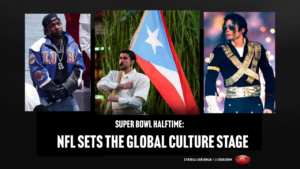
The halftime show used to be a bathroom break. Now it outperforms the game itself.
For decades, the Super Bowl halftime show was a logistical intermission. It gave stadium crews time to reset the field and viewers time to refill snacks. It was pleasant, safe, and largely forgettable. Now it’s a cultural tentpole.
That transformation did not occur because of bigger production budgets or more elaborate staging. It happened because the NFL learned how to use culture strategically. Over time, the league shifted from treating halftime as broadcast entertainment to positioning it as an instrument of cultural validation.
In 1990, the halftime show still resembled a regional parade. Super Bowl XXIV featured a “Salute to New Orleans” complete with local jazz elements and festive pageantry. It was competent and cheerful, but it carried little national urgency.
The first major reset came in 1993.

The Jackson Blueprint
Michael Jackson’s performance at Super Bowl XXVII fundamentally redefined the format. Rather than presenting halftime as variety entertainment, Jackson staged a global pop spectacle. Most notably, it was the first halftime show during which television ratings increased rather than declined.
Jackson’s presence attracted viewers who may not have cared about football at all. His performance sparked national debates around “family values” and incorporated themes tied to his “Heal the World” campaign and the social tensions of the early 1990s. It was not neutral. It was culturally charged. The NFL learned that a singular, globally resonant artist could expand the audience and elevate halftime from filler to feature.
The Defensive Era

The trajectory was not linear. Janet Jackson’s infamous “wardrobe malfunction” controversy with Justin Timberlake during 2004’s Super Bowl XXXVIII show triggered intense regulatory scrutiny. The NFL responded by moving into protection mode. For over a decade, the league prioritized stability, booking legacy rock acts like Paul McCartney and The Who. These performers were institutionally safe and unlikely to generate friction.
The strategy worked for risk management, but it was defensive. The league traded contemporary cultural relevance for operational insulation. Over time, the pattern was obvious: the safest shows were not the most resonant. They were the ones driven by a clear artistic vision, like Prince in 2007 or Beyoncé in 2013, where a singular point of view outperformed committee optimization.
The Architect Era

The decisive pivot came in 2019, when the NFL announced a long-term partnership with Jay-Z’s Roc Nation. With Roc Nation installed as the league’s live-music strategist and a key force behind the Super Bowl halftime show, the NFL stopped treating halftime as generic entertainment and began treating it as cultural positioning.
From 2020 forward, hip hop, R&B, and Latin artists moved to the center. This transition signals institutional alignment with younger, more diverse, and globally connected audiences.
Bad Bunny Is a Game Changer
Super Bowl LX in 2026 provided the clearest evidence to date. Led by Bad Bunny, the halftime show averaged 128.2 million viewers, surpassing the game’s 124.9 million average audience. More people tuned in for the cultural moment than for the competition itself.
In fact, Bad Bunny was not paid a traditional performance fee for his NFL Super Bowl halftime show beyond a standard union rate of roughly $1,000 per day, but the event was a major revenue engine. His appearance drove about $170 million in Media Impact Value, capturing roughly 39% of all Super Bowl-related coverage, an enormous boost for his long-term earning power across touring, sponsorships, and partnerships like his signature Adidas collaboration.
Despite political backlash and scrutiny regarding the Spanish-language performance, the FCC found no violations. The audience scaled. The conversation intensified. The NFL demonstrated it could underwrite culturally resonant performances while maintaining advertiser confidence.
Cultural Ratification
The halftime show now functions as a mechanism of cultural ratification. When the NFL places an artist on that stage, it is doing more than booking entertainment. It is signaling which identities, genres, and narratives occupy the center of mainstream legitimacy.
Bad Bunny’s performance crystallized this shift. His reggaeton-driven set foregrounded global Latin identity within the framework of the most-watched broadcast in American media.
For marketers, the lesson is clear: attention no longer flows to what feels safest. It flows to what feels meaningful.
And the NFL? It no longer asks, “Who is safe?” but rather, “Who defines the moment?” On the biggest stage in media, the league has positioned itself not simply as a host, but as a gatekeeper of cultural legitimacy.
Who’s your pick for the next halftime headliner? Comment below.
ABOUT LIEBERCOMM: Influence, Engage, & Build Brands: Stop blending in. Start being found. Amplify your story, boost your reach, and stand out with impact-driven LieberComm marketing and brand awareness campaigns. Own the story. Steer the narrative. www.cynthialieberman
